Deprecated: Function WP_Dependencies->add_data() was called with an argument that is deprecated since version 6.9.0! IE conditional comments are ignored by all supported browsers. in /home/customer/www/stevedorst.com/public_html/blog/wp-includes/functions.php on line 6260

Blog

The Bad, Boring, Blowhard Washington Nationals

 natsWe interrupt this regularly programmed blog on film and video so I can vent about something that I didn’t realize I cared so much about: the bad, boring, blowhard Washington Nationals.

They’re bad: 9th of 15 NL teams, with a losing record, 29-30. But they’re worse than their record indicates. Of 30 teams in baseball, the Nats are 28th in batting average, 27th in slugging average, 29th in runs scored, and 30th in on-base percentage.

Because they don’t score, they’re boring. At least the Colorado Rockies lose games 9-8 and fans can chat about the 10 home runs they saw! Yes, Strasburg and Harper are exciting, but they’re both injured (along with about a fourth of the team).

Worst of all (and it pains me to say this), the Nats are blowhard. When New York Jets Coach Rex Ryan predicted he’d win the Super Bowl in his third season, I thought he was full of it.

http://youtu.be/bKAMM2rZUgM?t=18s

That’s because since birth, I’ve been a Steeler fan. Steelers and their fans can be a lot of things, but we don’t tend towards acting the fool or self-aggrandizement. It’s about the team. And Coach Mike Tomlin is the anti-Rex Ryan.

Is Nats skipper Davey Johnson any different? His pre-season boast, “World Series or bust” became a rallying cry before 20 year-old Harper and 24 year-old Strasburg had even played a full season together!

And the DC media ate it up. It’s been a dry spell here. But sometimes you have to ask yourself whether it’s sports journalism or wish fulfillment. In fact, the hype has inspired a rash of Onion-like articles proactively inducting the pair into the Hall of Fame.

But this is American sports. Hyperbole rules. I get that. Big-market teams have big pocketbooks, hyped players, and braggart media. ESPN talking heads play armchair quarterback with all the reserve of Ann Coulter heckling an ACLU gathering.

Yet what I didn’t realize is that I cared so much.

After going to exactly one Major League baseball game in the two decades between 1992 and 2011, I’ve been to 20+ Nats games in the past two seasons. Where’d this passion come from? Did I catch . . . “Nattitude?”

SORRY PIRATES, I’VE FOUND A NEW MATE

I broke up with baseball at 11:52pm October 15, 1992. That was the moment Barry Bonds’ throw to Catcher Mike Lavalliere arrived a split second too late. The Atlanta Braves’ Sid Bream score the walk-off, overcoming a two-run deficit with two out in the bottom of the ninth to dispatch my Pittsburgh Pirates in the 1992 NLCS.

The Pirates of my youth were stacked: the power-hitter Bobby Bonilla, CF Andy Van Slyke, aces John Smiley and Doug Drabek, and a skinny kid named Barry Bonds.

But because the small-market Pirates couldn’t sign these budding stars to big money, they lost them all. In 1993, they finished 22 games back, and have been stuck there ever since.

I was only 20 at the time, and baseball and football were my favorite sports. But the way money dominated baseball didn’t seem fair.

So I broke up with baseball. Went cold turkey. Stopped pouring over statistics in the morning paper. Packed away my Topps mint-condition cards. Muted my amazement that Dave Kingman could ding 35 homers while hitting .210; stopped comparing Rickey Henderson to Lou Brock to Ty Cobb; Nolan Ryan to Steve Carlton to Sandy Koufax to Walter Johnson. Stopped it all.

Life went on. Studies, travel, new aspirations.

Lots changed in me, but little in baseball.

In 1992, when the Pirates lost Barry Bonds to the free-agent market, I wanted to be a college professor. The next year, I was an aspiring homeless advocate. By 1995, I wanted to be a professional piano player; in 1997, a management consultant, and (finally) in 2001 a documentary filmmaker.

All the while, the Pirates were losing, and I didn’t care. Baseball was dead to me. And it’s not clear to me if MLB tried to fix what ails it. In fact, the Pirates still haven’t had a single winning season. In 20 years.

OMG, DID I CATCH “NATTITUDE”?

Fast-forward. In Washington, D.C., with a family, career, and the Pirates-pain dulled by the passage of time, I didn’t see it coming.

The 2012 Nats snuck up on me. After their 2011 losing record, they became exciting! And it brought up a lot of great memories of baseball and my youth.  I started buying SRO tickets to watch this underdog team—hanging at the Red Barn, drinking IPAs,  and eating burgers at Shake Shack—just enjoying the new stadium!

I’d check stats in the morning paper, like I hadn’t done in 20 years, text friends with predictions on upcoming games, dissecting last night’s.

I was becoming a fan again.

So, as a new fan, here’s my two-cents: Nats, thanks for making baseball fun again. It’s been a while. I don’t need a World Series this year, nor predictions about it. Nats media: I don’t need the hype. I’m happy to see you build a good, solid franchise (perhaps like the Pittsburgh Steelers) that is in contention for many years to come. You’re a young franchise, and GM Rizzo seems to be doing a great job building young talent. Don’t start swinging your money stick around like the Red Sox, Yankees, and Dodgers. It cheapens the sport. Acquisitions like Jaysen Werth ($126 million) and Dan Haren ($45 million) remind me why I’m paying $9 for a lite beer. And it reminds me of the Pirates.

So, if I’m going to trade in my self-imposed baseball isolation for the big-market Nats, it only feels right if you do it with class.

Oh, and can you score some runs?
Film @ Egypt: Ahmed, Ambulance-Beater + 5 Videos

steve-liftRockEgypt, for me at least, is not one of those places you can parachute in and feel at home. It’s intense, with its own pronounced contours and customs.

A Washington, DC-based organization hired me to go to Cairo and film for four days. As DP and director, I’d pick up a unit producer and driver in country, (When I’m back home, I’ll write and edit a short documentary film).

Here’s a 1-minute clip from some stuff I shot on day 3 on a nature preserve. Check out the underwater clips!

Day 1 starts early. After a couple interviews, it gets fun. Khalil runs the agribusiness unit of a large company, so I decide to put us on motorbikes, winding through the vineyards on the way to his staff. Anytime you can ride on the back of a motorcycle, filming, and get paid for it, it’s good times . . . What a blast! Here’s a quick clip:

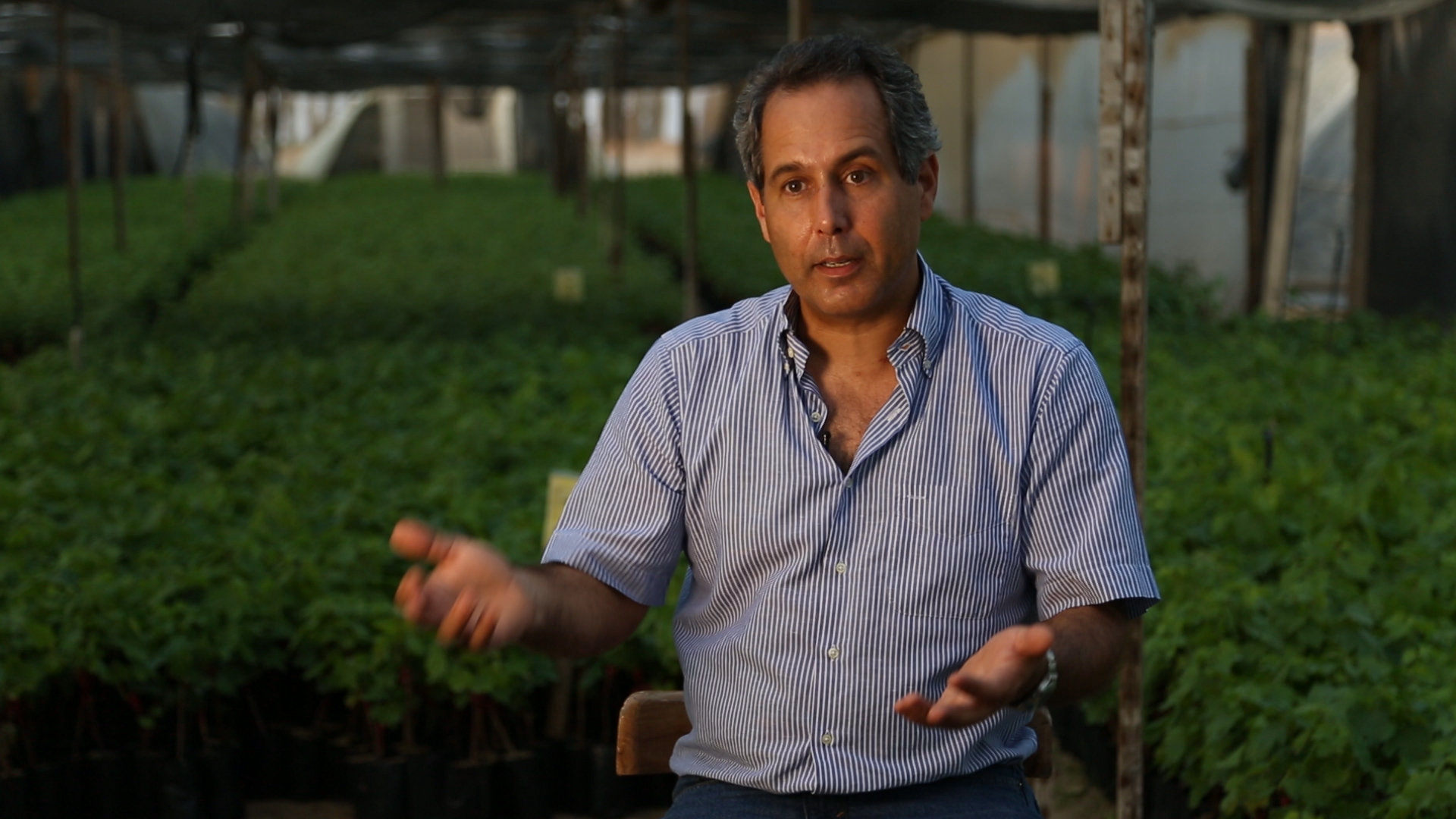
I decide to do Khalil’s interview in the greenhouse, since it’s quieter and there’s some shade. I get set up, using my Litepanel LED, then wait a bit until the golden hour is just right. Here’s a still (no color grading):

kstill-2

Anytime I can complete three interviews and some creative b-roll on day 1 in a new country, it feels great. This rosy feeling of accomplishment takes a hit, however, when my “unit producer” informs me she needs to “spend some time in the office” on day 2. She’ll be leaving me with the driver for beauty shots Tuesday around Cairo.

Anytime you can ride on the back of a motorcycle, filming, and get paid for it, it’s good times . . . What a blast!

This is well and good, except I speak no Arabic and Ahmed, my driver, speaks about 57 words of English.

Ahmed driver
Despite a language divide, Ahmed and I become fast friends

Now, I’ve shot city b-roll in some crazy places before, from Harare to Baku and Manila to Mexico City, but nothing compares to Cairo. Old lady drivers make Manhattan cabbies look like Zen Buddhists. It’s manic. Somehow things function, but it’s tight, chaotic, and extraordinarily loud.

After a lengthy argument, my unit producer relents—only to call at 10:30pm. She’s not coming; driver to pick me up at 7am.

I feel abandoned, but there’s work to be done. This is what it’s like to be an independent documentary filmmaker — you move forward, you solve problems, you do it all: shoot, run audio, direct . . . and I was ready to learn some Arabic along the way!

The next morning, Ahmed and I head to the pyramids. Without a unit producer, I wing it. Fortunately, Ahmed knows a guy who knows a guy. Because it is virtually impossible (and prohibitively expensive) to bring film equipment in the main tourist gate, I should get a horse and go around back where I can film the pyramids from a hilltop in the desert.

Good plan, right? Except the stable owner tries to get me to name the first price. Having lived in Cameroon—where people approach haggling with the vigor of Olympic athletes—I knew enough to wait.

“2,400 Egyptian pounds,” he offers. I laugh out loud. Stable owner wants $350. The next 20 minutes is a legendary back-and-forth where I feign disinterest, act like I’m walking away, and eventually settle on about $64. I immediately have this sinking feeling in my stomach that I could have gotten it for much cheaper, but I can’t haggle the whole day. I have a job to do.

A fence encircles the entire Giza pyramid area. It is reportedly 22 kilometers long. It probably helps the state capture more tourist dollars, because everybody has to enter the main gate, paying some 60 pounds.

Skirting the pyramid fence from the slum side is a start contrast. Dilapidated storefronts advertise horse tours or all-terrain vehicles. I pass a dead horse, a cemetery. Then we enter the desert:

mohammed-donkey
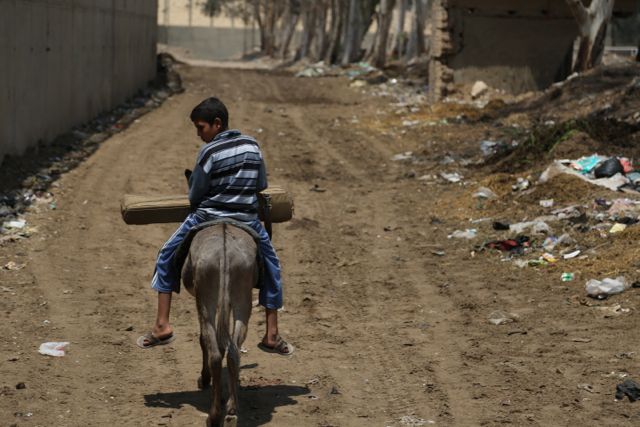
Muhammad knows no English, but is a nice boy who carries my slider to our destination. Thanks!

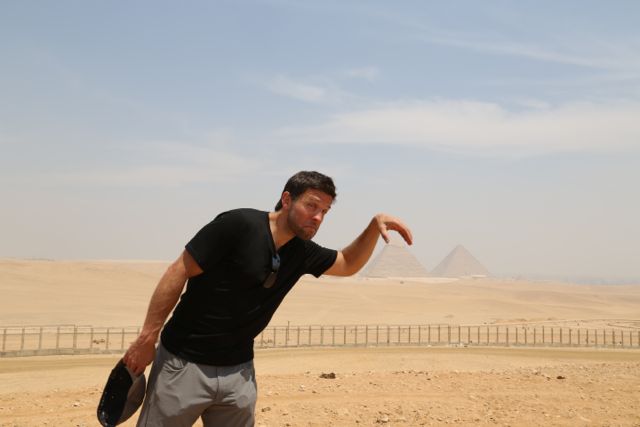
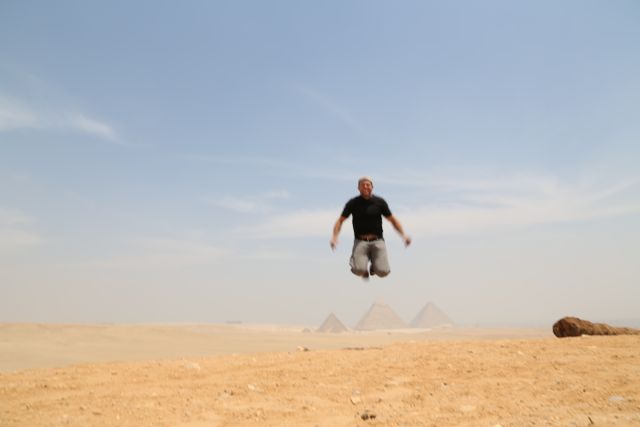
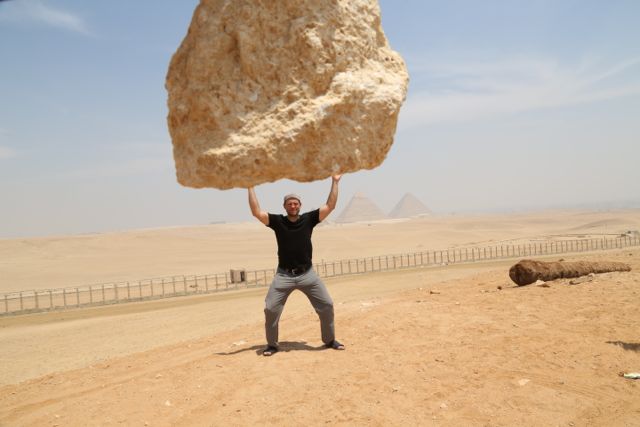
My guide, Ali, complains how tourism is way down since the revolution. He has a winning smile, and fortunately for me, a background in TV. When we finally reach the distant hilltop, and I capture the footage I want, Ali takes my camera and directs me with the confidence of a commercial director:

steve-hold-pyramidsteve-jump steve-liftRock

What saves the rest of day 2 is Ahmed, the driver. Every time I want to get out of the van and film, he makes it happen. Alternately, he charms security guards, tips people to watch our van, and finagles our way behind locked gates. Thank you Ahmed! You are a lifesaver.

At Muhammad Ali Mosque at sunset, Ahmed and I capture a stunning silhouette of this historic building:

Day 3 promises adventure. We’re accompanying the CEO of the company to an innovative pilot project where they’re raising seabass in a saline lake, Al Fayyum. The drive is only 150 kilometers, but because we start in central Cairo, it takes four hours.

Despite the 95-degree heat, this is my favorite day. Any time you can film on a wooden rowboat and underwater with a GoPro on a monopod, it’s cool. The clip posted up top is from this day.

The rest of the afternoon we take our time heading back to Cairo. At golden hour, we come across a family harvesting wheat. While my unit producer (back with us today) stays in the van on her phone, Ahmed jumps out with me. He spreads some small tips around to the grandfather and the children just to say “thanks,” as I film the family in action:

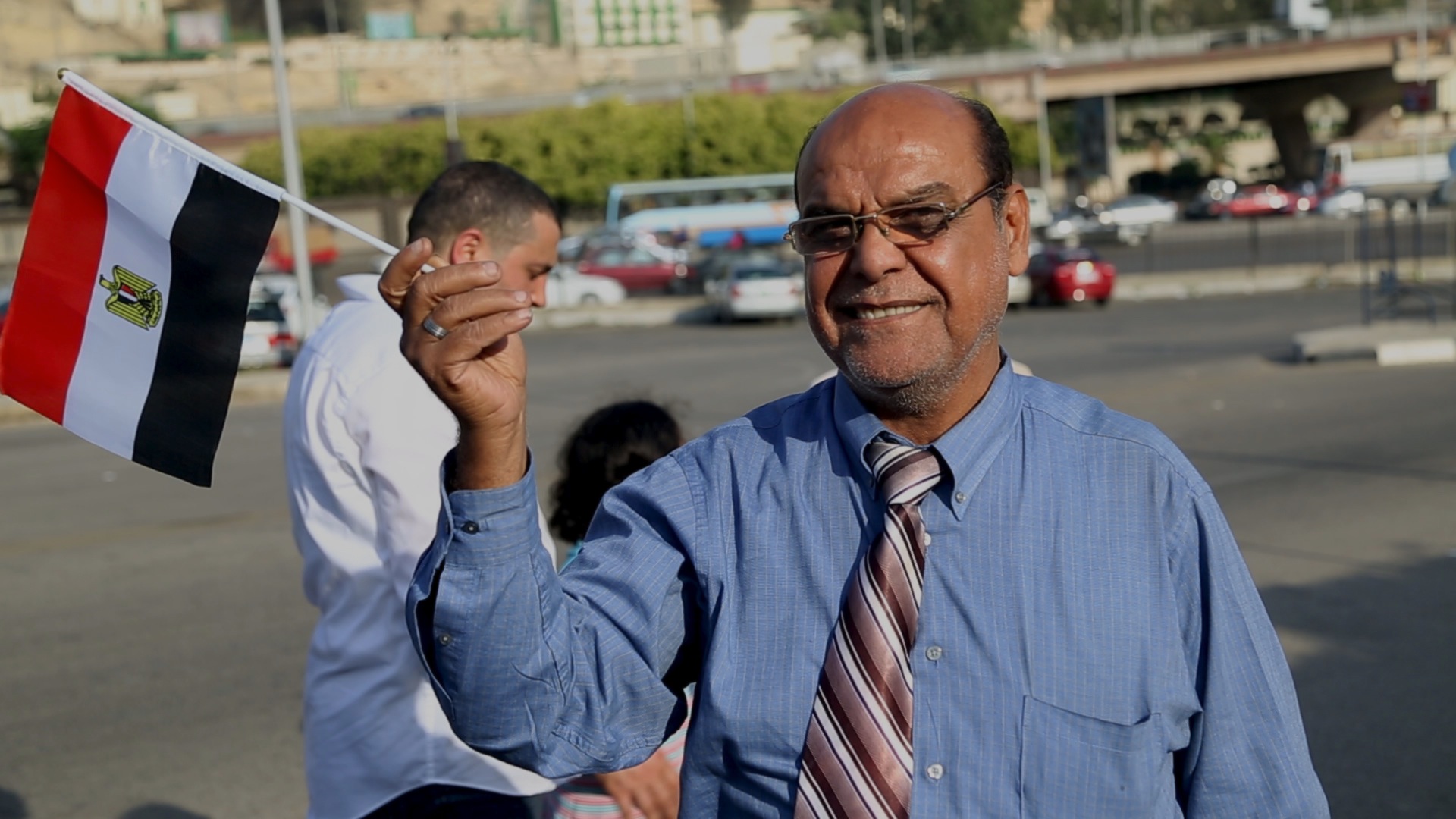
We continue down a rural road. The light is so nice, I jump out. Soon, outgoing young men gather around. They’re curious. Ahmed explains what I’m up to, and they enjoy hamming it up for the camera:

Day 4, I do an interview, spend some time with the company, and then spend an afternoon getting broll around the city. At sunset, Ahmed invites me for “koshari.” It’s yummy, and a fitting end to an intense week.

Because my flight departs at 4:35am, I awake at 1am, and Ahmed picks me up at 1:30. What we don’t count on is a big accident on a bridge, and I’m dangerously close to missing my flight. We’re going nowhere. And what’s not helping is a sea of gawkers who arrive on motorbikes, park them on the only functioning lane, and start directing traffic of their own accord. Where’s the police? Where’s emergency services?  . . . At a snail’s pace, we creep forward to the scene, which has the vibe of a democracy demonstration more than a traffic accident. At that moment, Ahmed spies an opening. An ambulance breaks free from the scrum. Ahmed reacts. We are hot on its tail, and race through the city at breakneck speed.

Eventually, even the ambulance is going too slow. Ahmed, with commentary, leaves the ambulance in his dust!

I make my flight! And head back to Washington, D.C. Thanks my friend . . .

Cherry Blossoms: Naked and Famous

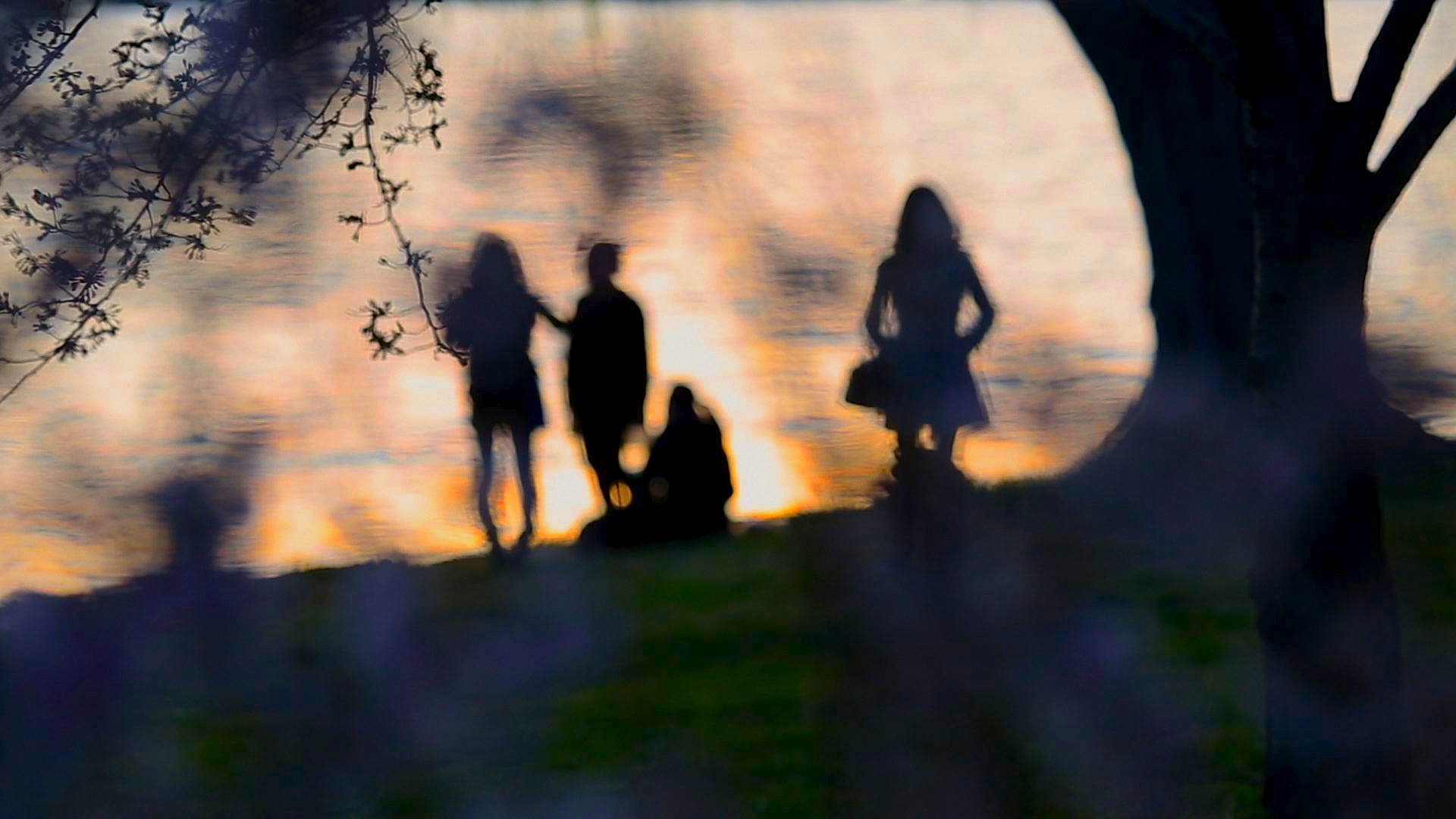
silhouetteEvery spring here in D.C., the cherry blossoms come out and the city shuts down. I decided to go to the tidal basin for a few hours and take part in the mayhem . . . through my camera lens.

I set up at three locations: by the MLK, Jr. Memorial, around the corner facing the Washington Monument; and across the polo grounds on the banks of the Potomac. I brought the Canon 5D Mark III, the MYT Works glider, and several lenses: 16-35mm, 24-105mm, and 100-400mm.

I didn’t have a shooting plan. I was just having fun. Lots of tourists stepped through the frame, smiling, happy, with good energy. A Japanese woman with friends. A picnic at water’s edge. The golden hour gave way to blue.

I edited the footage today. I decided to use “Jilted Lovers” by the New Zealand band, The Naked and Famous. What inspiration? I pictured that Japanese woman. What if these lyrics were her story? What would capture her eye? What would she be thinking? Would she give in to bittersweet nostalgia? Or could she find release in the beauty all around her?

I decided to go to the tidal basin for a few hours and take part in the mayhem . . . through my camera lens.

The clip runs just short of 3 minutes. Hope you like it.