Deprecated: Function WP_Dependencies->add_data() was called with an argument that is deprecated since version 6.9.0! IE conditional comments are ignored by all supported browsers. in /home/customer/www/stevedorst.com/public_html/blog/wp-includes/functions.php on line 6260

Blog

Happy New Year!

Really excited for 2013. Bench to Bedside, the new TV series that I’ve been DPing and editing for the past two years, was acquired by Australia Broadcasting Corporation for global distribution. Not sure what channel will see the program domestically. “The other” ABC seems to be one of the biggest players in the Pacific Rim, so interested to see what they’ll do with it.

Some fun shoots I’ve done lately include an interview Friday with World Champion figure skater Kimmie Meissner. For an elite athlete, she was really down-to-earth. The shoot posed its own unique challenges, as I found myself setting up lights and c-stands on ice. This was for a TV series distributed by Fox called The Real Winning Edge. I learned that Meissner co-founded the Cool Kids Campaign, an organization for kids with cancer. And she told me she’s going to NYC next week to do a show with Barry Manilow. So, will Barry be on ice skates?

Saturday night, I found myself stifling an urge to laugh. Not because I’m a killjoy, but because I didn’t want to shake my shot! At DC’s historic Lincoln Theater (within nose-shot of Ben Chili’s Bowl!), I was helping out old friend Chris Billing on his latest documentary. I followed Atlanta-based comedian Small Fire verité-style (Small Fire’s YouTube channel): to her green room, backstage, joking with the band while waiting in the wings, and finally on stage for a 40-minute set that had a SRO-crowd hooting and hollering. Small Fire riffed on her upbringing in the church (which I could identify with), although her church sounded a lot more fun than mine did!

2013, starting off real well!


—————————

Fireworks photo by Rob Chandler, from: http://bit.ly/VlpjIK

Mecánico as Film Crew?

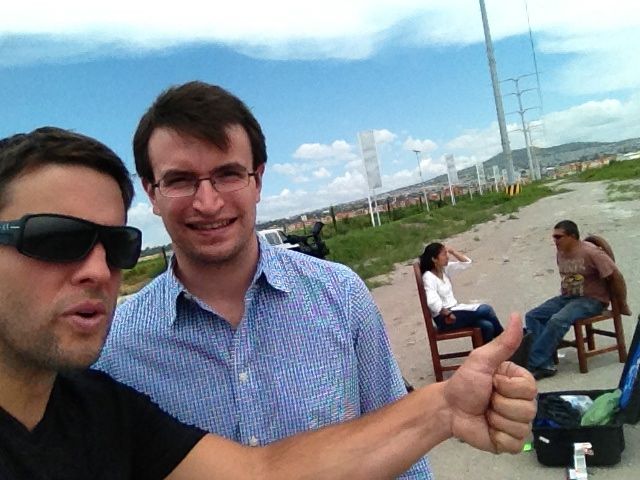
Delfino’s a cypher. I’m riding shotgun with this 40-something Mexican, camera in my lap, finished filming for the day in Mexico City. Delfino’s on about some subtle details of a fuel-injected engine. In English.

I hold up my hands in protest. Sorry man, I don’t understand a thing. He keeps at it. Turbo this, catalytic that. I smile.

Delfino’s clearly a master at his mechanic trade, but he can’t read or write. He’s fluent in English and Spanish, but struggles to make ends meet.

I’m here to make a short film for a DC-based group that invests in Vinte, an affordable housing company. Delfino is a first-time homeowner in a Vinte complex, where units start at $23,000.

How does the company do it? Partly it’s economies of scale. Delfino’s complex will eventually have more than 5,000 units. But it’s also the novel condominium business model, with security, paved roads, and reliable water, lights, and Internet. It’s a stellar option for people who grew up in Mexico’s messy informal settlements.

I’ve spent parts of three days here and have to admit, the neighborhood’s nice. It’s clean, quiet, and safe. Delfino’s three children, all younger than age seven, love the community park that has a biking path, basketball court, and jungle gyms.

We do the interview here. For Delfino, it brings back a flood of memories. His parents moved to California when he was a toddler (which explains his mastery of English). He dropped out of school at age nine, but rebuilt his first car engine at ten. His face lights up talking about that first car, how it won a race, how he realized he could build things. He had a gift.

When his father returned five years later, Delfino’s mom enrolled him in school, but it was far too late. Delfino was making good money as an apprentice mechanic. And besides, school was tough. Fixing cars was easy.

The interview wraps. In my ten-plus years working as a filmmaker, I’ve never let a subject help on set. Many volunteer, but it’s a polite gesture that I politely refuse. Before I realize it, Delfino is dismantling lights and rolling cable. He insists it’s his first time around this type of equipment. We work silently, as if we’re a team. Of course, he manages to pack everything up just right.

As he closes the last pelican, I reflect that this is why my job is so cool. Yes, the travel is incredible. But the best thing by far is the personal connections. And it’s the documentary process that I have to thank for it. The peculiar way that reality, premise, and personal narrative combine to create something unpredictable and authentic—and periodically, sublime.

Delfino’s had a hard life, but he’s in a good place now providing for his family. He opened up his life for a few days and I’m better for it. The master mechanic with the irrepressible smile.


Repairing the Shattered Sky

I wanted to share a great follow-up to my Bloomberg article last week. Policy Innovations, a publication of the Carnegie Council, ran a Q&A with me entitled Repairing the Shattered Sky. Editor Evan O’Neil asked some tough questions. I call climate negotiations “medieval trade fairs” and US politicians “cowards.” I hope you have a chance to read it!

It was good fun, particularly thinking about the film and the issues it raises through Carnegie’s lens: ethics. China came up a lot. The moral and practical responsibility of Americans to act on climate change came up as well. Hope you can read it!