Deprecated: Function WP_Dependencies->add_data() was called with an argument that is deprecated since version 6.9.0! IE conditional comments are ignored by all supported browsers. in /home/customer/www/stevedorst.com/public_html/blog/wp-includes/functions.php on line 6260

Blog

Solar, Kiva, and How to Change the World

kiva copyI went to my 20th college reunion last weekend at Rhodes College in Memphis, Tennessee. It was insanely entertaining catching up with people, most of whom I hadn’t seen in two decades. Writing “two decades” just made my fingers tremor. How am I old enough to be 20 years removed from anything—much less, you know, a college graduation?

Anyway. Wandering through the hallways of Townsend with James and Courtney was particularly nostalgic. But beyond the material memories (that paintings, those couches, the still un-tuned piano) I was attentive to an existential difference—back then, I lived a blessed non-linearity, characterized by marathon debates and the expanded sense of possibilities that youth conveys.

In this very common room, I defended the existence of God in a late-night debate against a guy named Graham (he was pretty damn smart; he won). That table over there was where I studied for my favorite class, “Hunger, Plenty, and Justice.”

We knew we could change the world.

Back in DC yesterday, I found an email from Kiva telling me I had $148 in available credit. I haven’t done much on Kiva for a while and it got me thinking again about changing the world.

Kiva is a San Francisco-based nonprofit that connects people through lending to alleviate poverty. Since it was founded in 2005, more than a million people have lent almost a half billion dollars in 73 countries. They have a 99.03% repayment rate.


In the spirit of college-worthy debate, I challenge you, faithful reader, to name a single development innovation that, if spread worldwide, could do more than distributed solar to raise the living standards of the poorest of the poor.

I joined Kiva in March 2007. Since then, I’ve deposited $672. I’ve made 121 loans to the working poor in 53 countries. When they pay back, I re-loan the money, so I’ve lent about $3,100 now.

A few years ago, I became disillusioned because I saw a lot of people lending for stupid reasons—so somebody could open a bar or the like. Nothing innovative. Nothing the local market wasn’t already supporting.

So after complaining a bit, I created a Kiva team called “Solar Explosion.” This was while I was directing a documentary about climate change, and I got really excited about the potential of distributed solar power. It could leapfrog the rural poor in the developing world out of abject poverty.

On the “Solar Explosion” team page I wrote: “1.5 billion people still lack electricity. Only a global solar explosion can change that and end poverty.”

And in the spot where you write “About us,” I put: “We know if you really want to fight poverty, you start with distributed renewable power – harnessing the sun in your own backyard! Micro-solar technology already exists that can transform people’s lives. The problem is that banks are only financing the old model: centralized power stations and expensive transmission grids. We lend to inspire awareness, so microfinance does more and more solar financing projects. Our goal is a solar explosion! Join us today!”

In summary: small-scale solar technology exists, but the financing doesn’t. It’s gonna take tailored models in different countries so poor people can do solar power in their own backyards and pay it off over time.
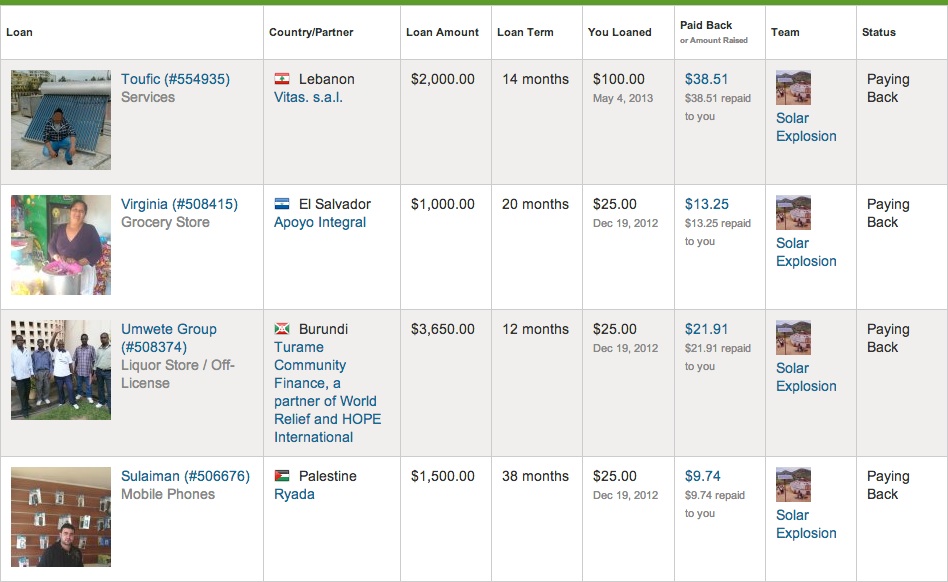
Some of my recent loans

“Solar Explosion” started slow, but today, there are 51 members who’ve made 572 loans to the tune of $14,525. Still not much, but a start.

In the spirit of college-worthy debate, I challenge you, faithful reader, to name a single development innovation that, if spread worldwide, could do more than distributed solar to raise the living standards of the poorest of the poor.

With electricity, children study more, get smarter, and perhaps get better jobs; family members are more productive, perhaps doing small businesses from home. And everybody is connected to the outside world, by simply plugging in a TV or charging a cell phone.

At the end of the day, there are tons of people who know way more than I do about distributed solar, about solar financing, and what the bottlenecks are. And perhaps Kiva’s not the best way to jumpstart this.

But it’s one way.

If you join Kiva, join “Solar Explosion.” Lend to green projects, especially solar.
Cycling: 7 Reasons “OMG WTF” is the Cruelest

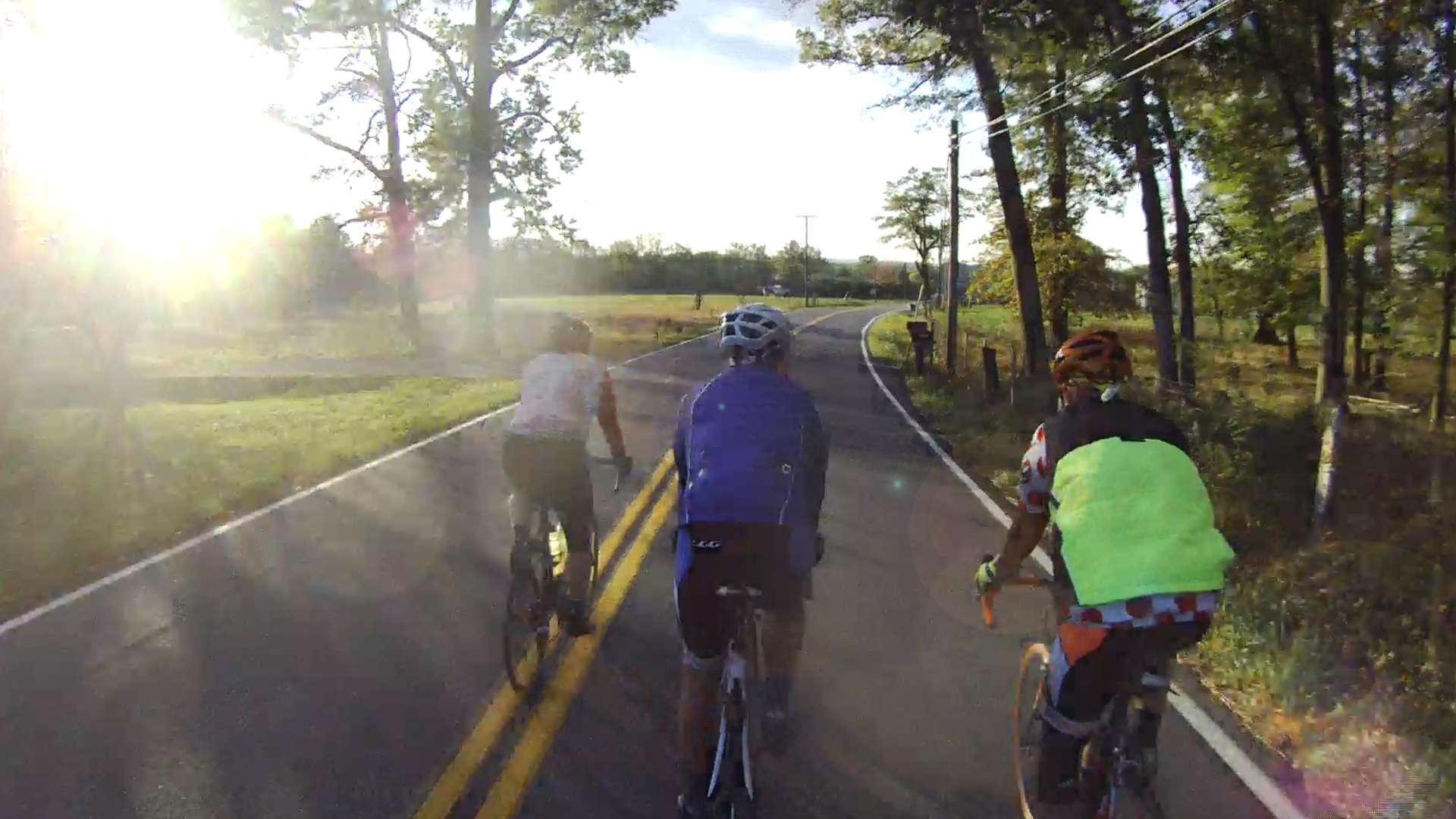
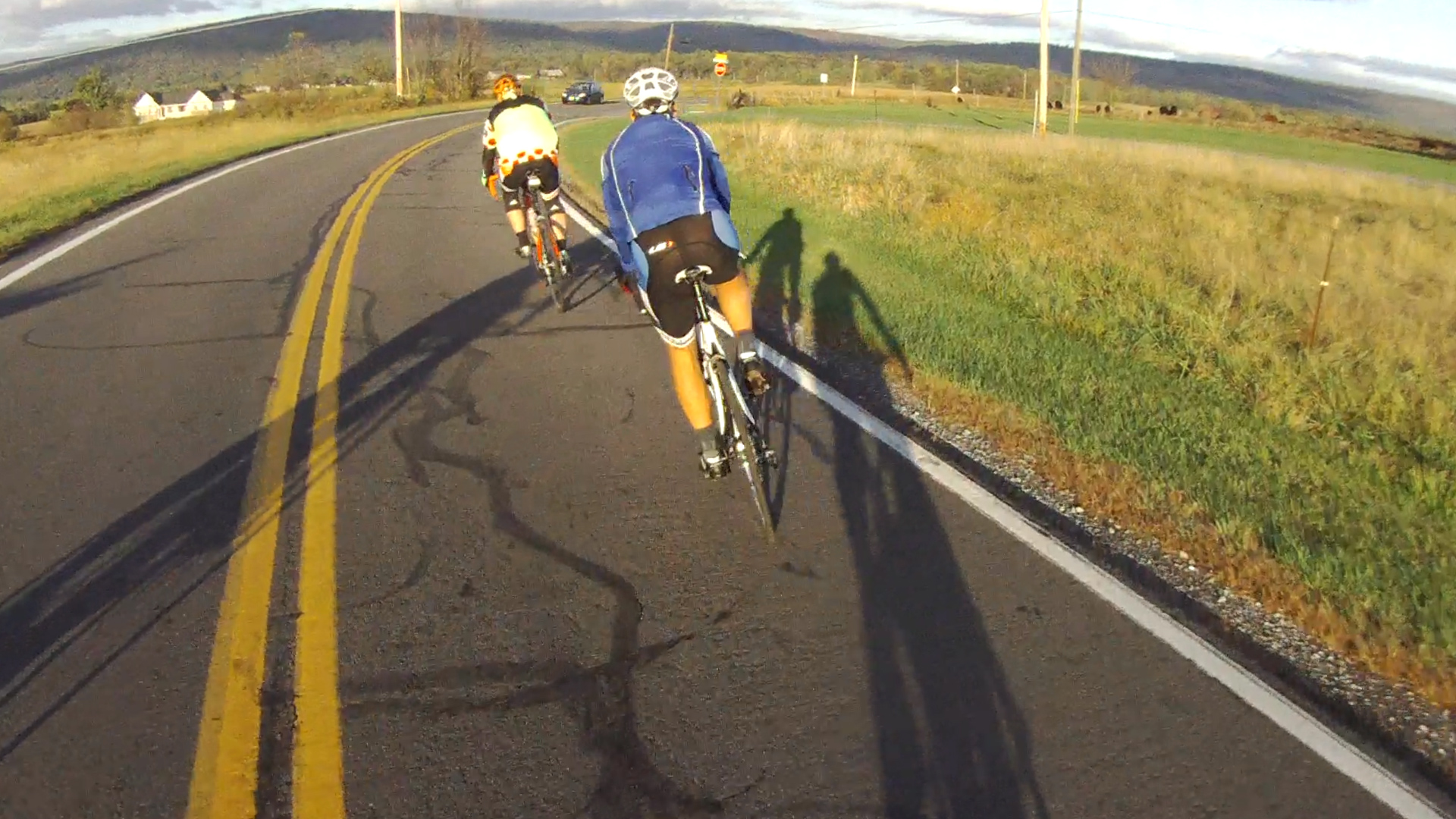
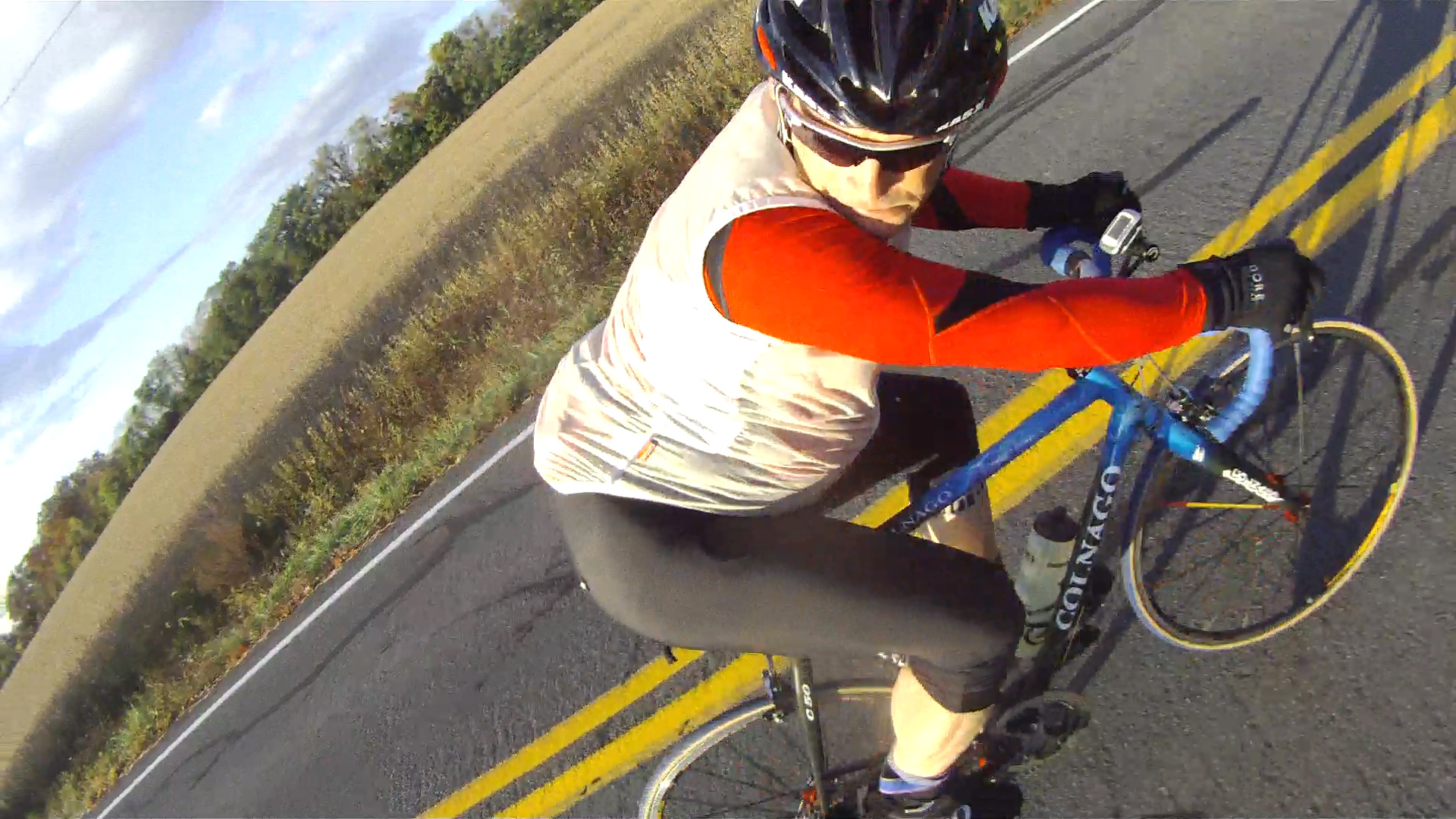
OMG WTF v2.Still005I didn’t name it, but it’s spot on. The “OMG WTF” ride is the hardest ride I’ve ever done. It chewed me up and spit me out; put me between two pieces of white bread, and served me for school lunch. I went riding recently with a few cycling friends: Bill Berlin, Jay Stanley, and Bill Murray. We leave Arlington at 6am to miss Beltway traffic, and start pedaling around 7:30 from Frederick, MD.

It‘s my first time to tackle this route, which seems to have been designed for maximum elevation and suffering. It’s a figure-8 in and out of Gambrill State Park on Catoctin Mountain. With at least four categorized climbs (Cat-3), it’s a legit test. Lots of quality cyclists seem to come here: on Strava, 467 cyclists have ridden the first mountain climb, for example, over 1,400 times.

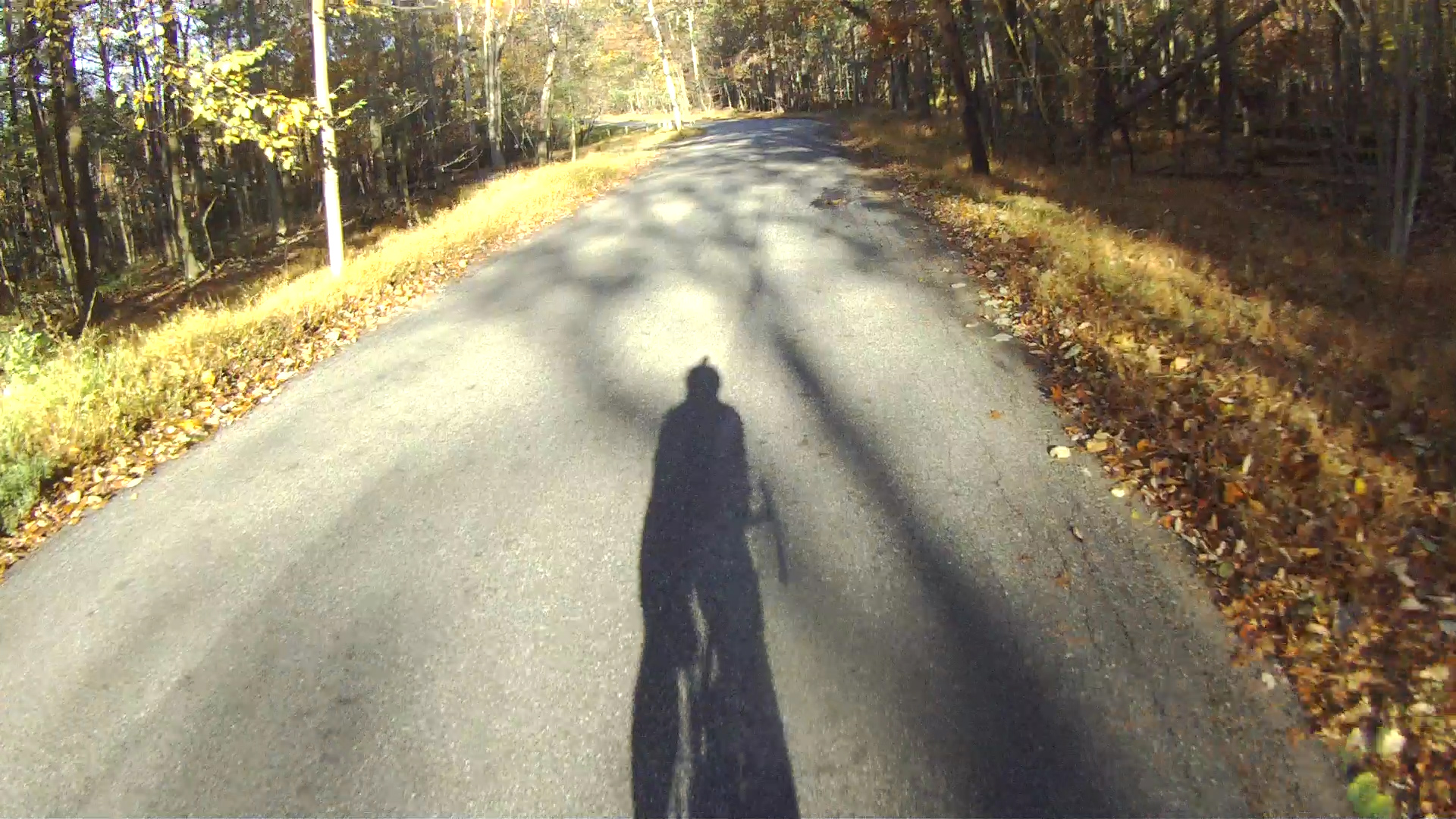
Jay’s Contour helmet cam captures some surprisingly good footage:


1. Reason #1. Hamburg Road

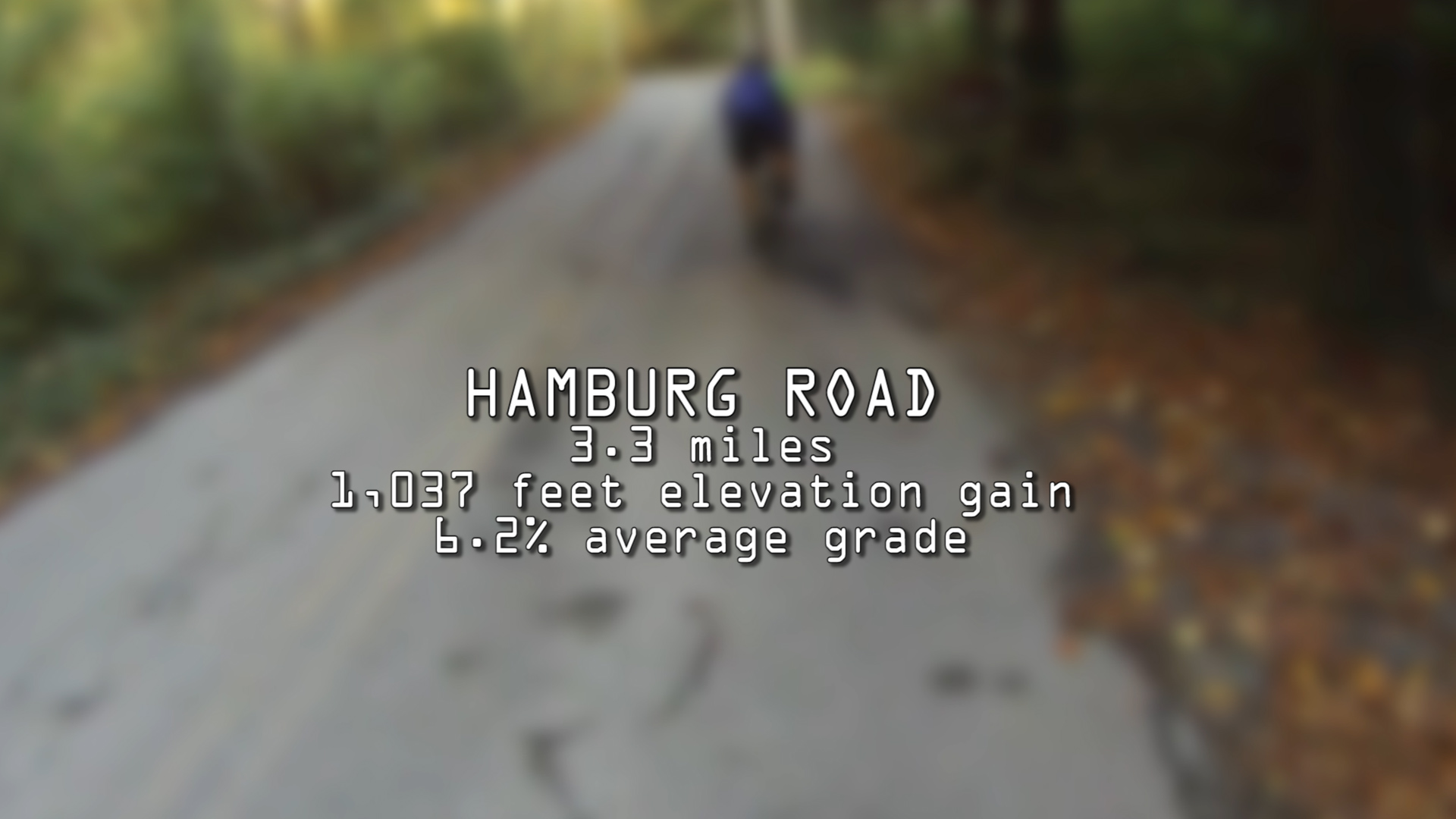
The first climb is up Hamburg Road, and it’s a doozy! It’s 3.3 miles long, with more than 1,000 ft of elevation gain (6.2% average grade). It takes me about 21 minutes and I average 9 mph. It’s incredibly painful, and I know I’m in for a long day, since I’m reduced to constantly checking my bike computer, doing fast math: “OK, I’ve gone 9.1 miles, 60 to go” . . . and an eternity later . . . “OK, I’ve gone 9.2 miles, 59.9 to go!”


2. Reason #2. Harp Hill

The second hill, Harp Hill, is “only” 1.8 miles. It’s also a cat-3 climb, but shorter — and as a result, not as painful. I cover the 630 ft elevation gain (average grade of 6.7 mph) at a slower 7.9 mph. Bad news: I’m slowing down.


3. Reason #3. The crosswinds

The next 15 miles or so are no picnic, to be sure, but they’re rollers and fun. It’s a beautiful Autumn day, with the sun streaking through the trees. Unfortunately, the crosswind is unpredictable and strong. It gusts upwards of 15-17 mph. Fortunately, most of the climbs are protected, narrow roads. But some of the open descents are too windy.


Part of the pain is that you’ve already done 57 miles and climbed more than 5,000 feet when Coxey smacks you in the face.


4. Reason #4. Middlepoint Road

Middlepoint Road starts to wind upwards at the 35 mile point. Having not ridden much the previous two months, I was dreading this. It’s 1.8 miles long, with 740 ft of elevation gain (with an even higher 7.3% average grade). I’m just trying to survive.


5. Reason #5. Coxey Brown

Jay is talking about how Coxey Brown is the hardest hill he’s ever done, and I just want to get it over with. Part of the pain is that you’ve already done 57 miles and climbed more than 5,000 feet when Coxey smacks you in the face. It’s insane: 1.9 miles long, with 1,024 ft of elevation gain, and 9.6% average grade. No rest for the weary!


6. Reason #6. 5.3 mph

Midway through Coxey, I feel like it’s my first day ever on a bike. It’s a old, narrow one-lane road, with odd off-camber turns and cracked asphalt. It’s not even 60 degrees this afternoon, but I’ve unzipped both my jacket and cycling shirt as far as they’ll go. It takes me 24 minutes to reach the top—at a paltry average speed of 5.3 mph!


7. Reason #7. The paperboy

When you suffer like this, you do things to survive. From the get-go on Coxey, I pull out a shameless maneuver: the paperboy. You know, riding far left and far right, just to manage the slope and stay on the machine. Far in front of me, Bill Berlin is pushing his Trek straight up Coxey. Respect!

Coxey has claimed another victim, but today it’s not me. Torquing up the extreme grades, Jay busts his hub. He ends up running up the hills next to his bike, then gliding down them—covering 6miles this way until we pick him up on the way back to Washington, D.C.

OMG WTF. If you’re ready to test yourself, do it. It’s a helluva ride.

Directing in Kenya, Distributing in Tokyo

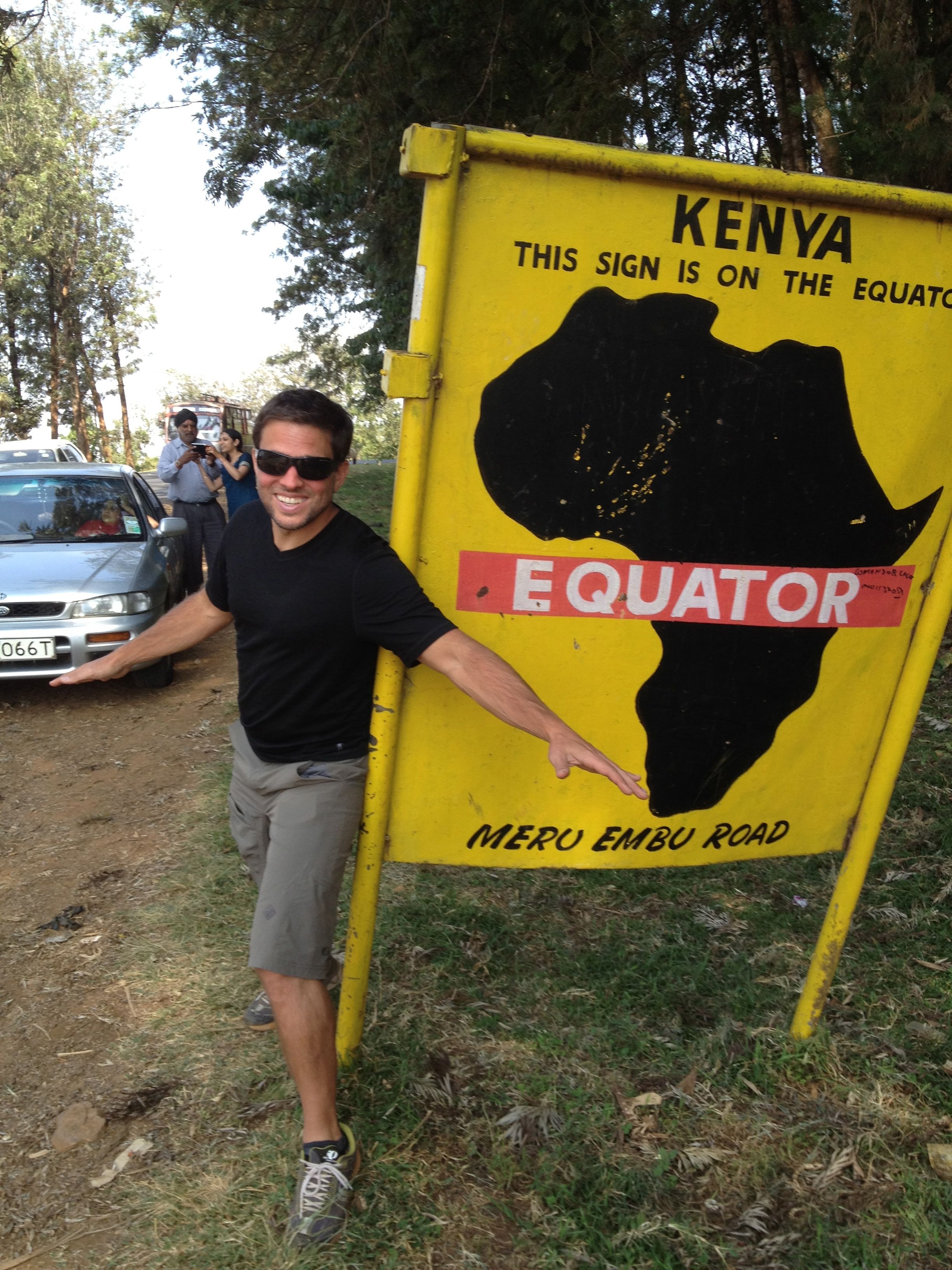
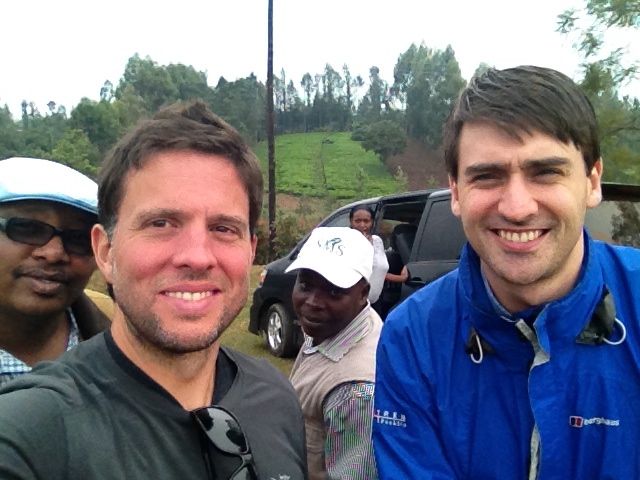
steve-equatorNairobi’s Westgate mall terror had not yet seized headlines when I left Washington, D.C. to direct and shoot a short documentary there. While I’ve been all over central Africa, it was my first time in Kenya. I stayed at the Nairobi Fairmont, which had all the old-world charm of a century-old safari hotel, as well as a dash of unsettling colonial vibe.

The DC-based World Bank Group has sent me to a lot of countries in the past few years to document what it’s doing on the ground. You can take issue with how successful the institution’s been in some countries or some sectors, but I like what I’ve seen. Lately, I’ve been serving as director, shooter, editor — and I’ll usually work with a DC-based producer and a unit producer in the field.

This time, it’s the Inclusive Business unit of the IFC, or International Finance Corporation—that has me in Meru, Kenya on a coffee farm. When we get there, our coffee farmer is nowhere to be found. We scramble to find a replacement. Soon, I find myself filming a day in the life of Cyrus Kinote, his wife Rhoda Nkirote, and their two darling children.

steve-kids
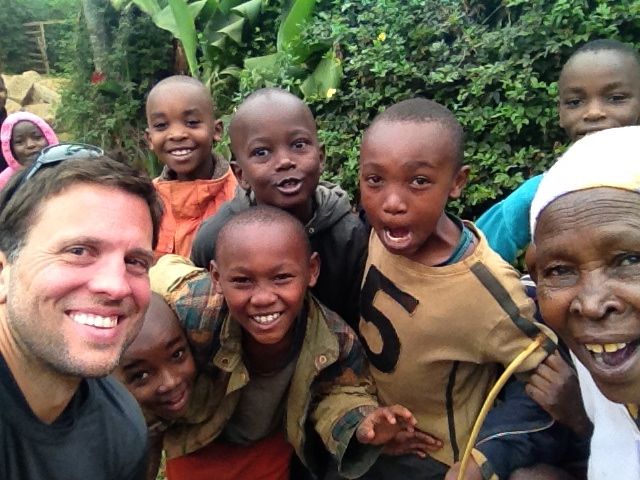
Sometimes, the craziness just overtakes you . . . 

I direct and shoot, and enjoy working with IFC producer Marcus Watson, who has a good eye. I know this will be more believable if we let Kinote tell his own story, documentary style. I also want the visuals to show his agency and dynamism. So many development videos are bad because they have top-down narration and don’t really give space for the voices of the poor. I resolve to do better. Today, I want to film how Kinote earns a living, spends time with his family, and collaborates with his colleagues. I want to do it all from his point of view. In so doing, I hope the viewer might empathize with Kinote, and care that his life has improved.

Today, I want to film how Kinote earns a living, spends time with his family, and collaborates with his colleagues. I want to do it all from his point of view.

They say that working with animals or children can double production time. On Kinote’s farm, this definitely holds true. Kinote’s cows are lowing like it’s their job, perpetually interrupting the master interview! Finally, Kinote throws some extra food in the stall, and we buy ourselves a window of time.

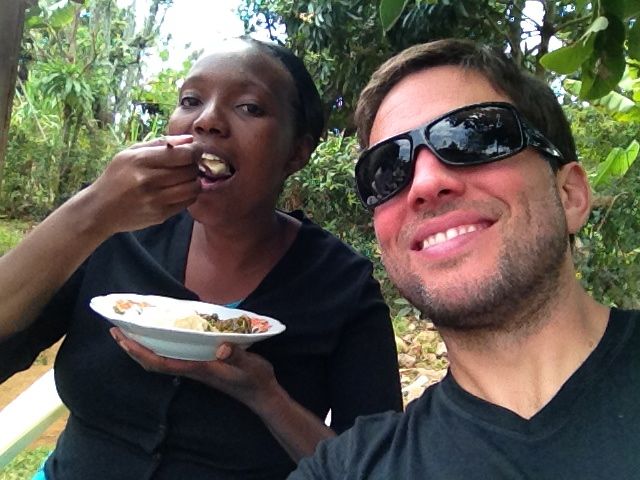
Rose Moseti is a stellar unit producer (sorry for the eating pic, Rose!). She works for Camerapix, Kenya's best video production company: http://www.camerapix.com/
Rose Moseti is a stellar unit producer (sorry for the eating pic, Rose!). She works for Camerapix, Kenya’s best video production company: http://www.camerapix.com . . . Below, Marcus Watson is a fun producer to work with. He’s since left the IFC to take a job in Kenya.

Late in the day, I film a series of shots with the GoPro, where I affix the little POV camera all over the place: in a coffee tree, a pile of coffee berries, and a wheelbarrow—even around Kinote’s chest. The end result appears as a short montage starting at 2:29.

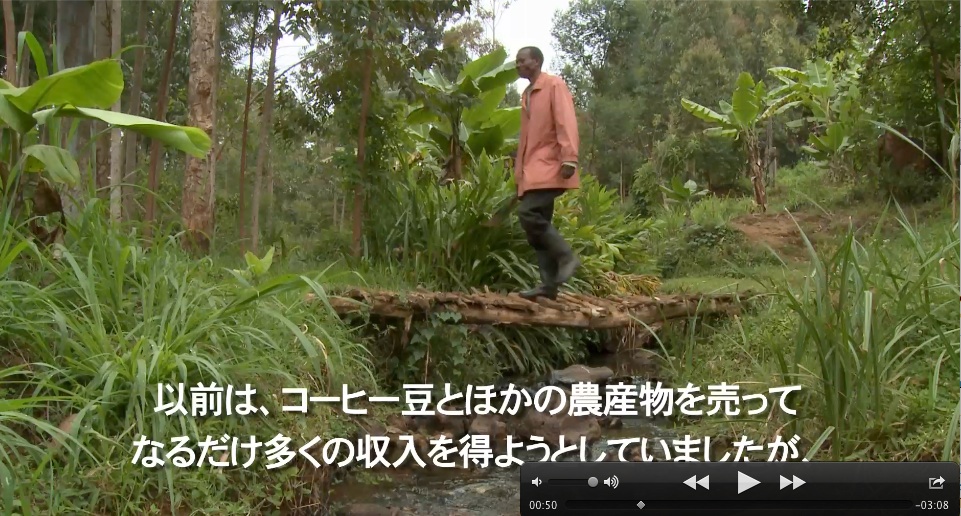
We did the interview in Kinote’s native Kikuyu. Back in Washington, DC, I edit the story and dub in English. It turns out that the IFC also wants a version to show to some important stakeholders in Tokyo, so I master a second version with Japanese subtitles.

For me, it’s a first: from Meru to English to Japanese!

steve-anthony
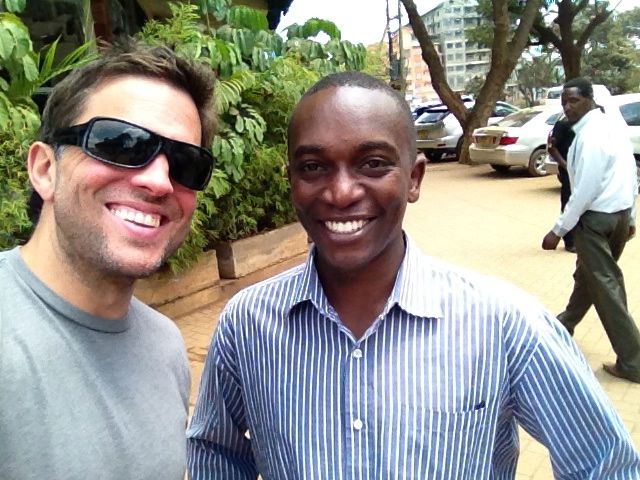
I really enjoyed getting to know Anthony Ngugi, who works for Ecom SMS, the outfit that trains all the coffee farmers and gives them market access. Anthony’s a charismatic guy who seems to relate equally well with the uneducated farmers and the company executives — and comes from a farming background hiimself.
Here's a still from the Japanese version. This is Kinote crossing a stream to his coffee fields.
Here’s a still from the Japanese version. This is Kinote crossing a stream to his coffee fields.